.webp)


.webp)


.svg)


Articles & Insights
The Two-Minute Rule
July 22, 2026
July 2, 2026

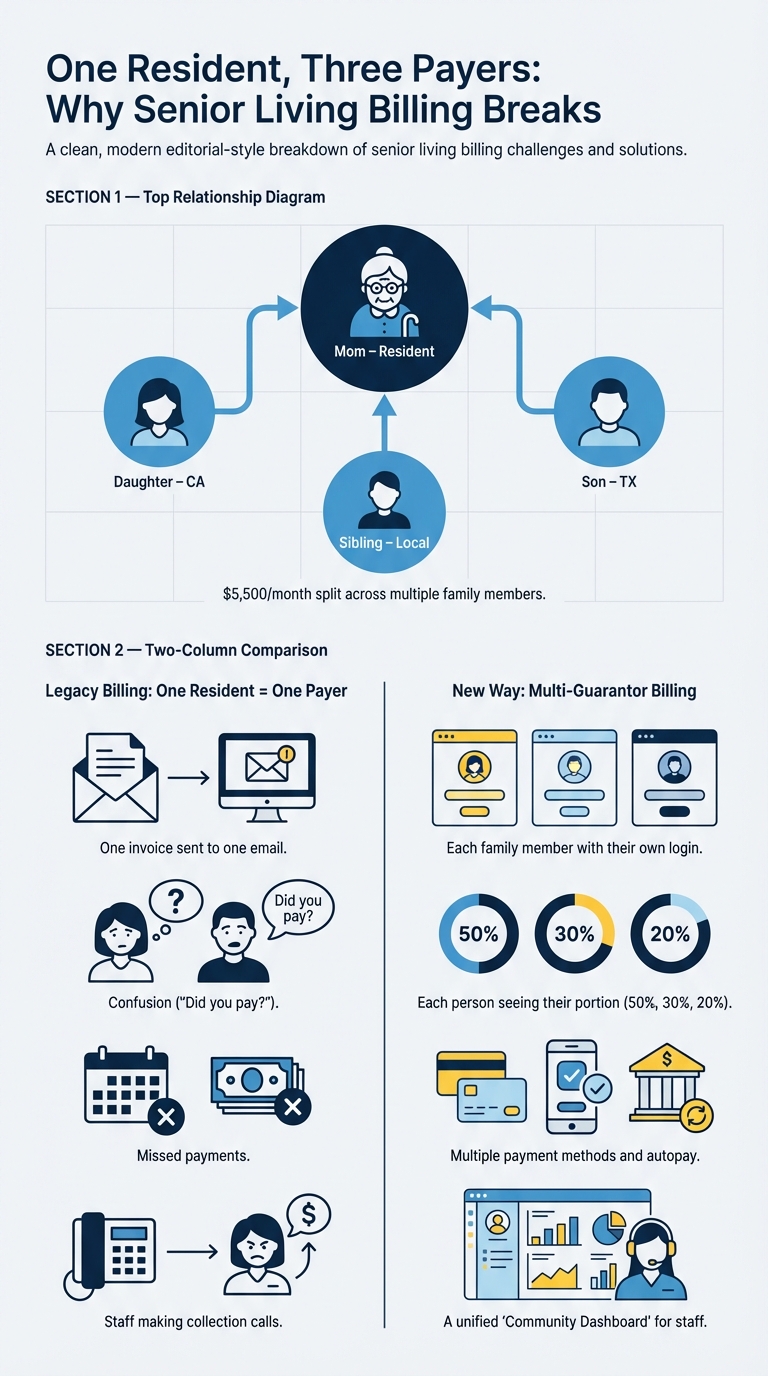
One adult child in California. Another in Texas. Their mom in a Florida senior living community. Each of them needs to see what's owed, manage their own payment method, and get real-time updates when a payment clears.
Traditional billing systems treat this as one resident account. Reality? It's a coordination nightmare.
Senior living communities operate in a fundamentally different billing reality than hospitals or medical practices. Residents aren't patients. Billing relationships span multiple states and multiple family members balancing caregiving with full-time careers. Monthly charges require predictable, recurring payment structures that most healthcare payment platforms were never built to handle.
PatientPay spent years solving complex payment challenges in traditional healthcare. In 2025, senior living communities started coming to us with a specific problem. We listened. Then we built something purpose-built for how they actually operate.
Senior living communities represent a $100+ billion market with characteristics that make billing uniquely challenging. Residents are long-term occupants. Charges are monthly and recurring. But here's what generic payment platforms consistently miss: the family coordination layer.
Multiple family members often serve as responsible parties. Not one patient and one insurer. Not a single point of contact. Multiple adult children, often living in different states and time zones, splitting monthly costs that can exceed $5,000.
The current pain is real. 76% of patient billings go uncollected across healthcare, but in senior living communities, the collection challenge stems from a different source. It's not insurance complexity. It's busy adult children with good intentions who forget to pay because the bill went to their mom's email. Or they're unsure if their sibling already covered it. Or their payment method is on file, but no one knows whose.
Here's another problem: Only 22% of consumers say they always know how much they owe before a service. For senior living communities families, multiply this confusion by multiple people, multiple time zones, and monthly recurring charges.
Communities don't need a healthcare payment tool shoehorned into senior living. They need a platform that understands senior living communities' operations from the ground up.
Two adult children splitting their mother's $5,500 monthly senior living community charge. One in California with a demanding startup job. One in Texas managing kids and aging parents. Both are responsible parties.
Current reality looks like this:
PatientPay's multi-guarantor solution changes everything.
Each family member gets their own login with visibility into their portion of the bill. Real-time notifications keep everyone informed without the "did you pay?" group texts. Multiple payment methods on file. Multiple autopay configurations. Automated coordination that reduces manual staff intervention to near-zero.
One dashboard for Senior Living communities administrative teams to see payment status across all guarantors.
This isn't a nice-to-have feature. This is what families actually need. Communities that offer it reduce friction, improve cash flow, and let administrative staff focus on resident experience instead of payment follow-up.
The adult children managing mom's billing are tech native. They expect online payments, automated notifications, and multi-user access. They won't tolerate clunky processes.
The data is clear: 72% of consumers under 35 have switched providers or are willing to do so for a better healthcare payment experience.
Translate this to senior living communities. When adult children evaluate communities for their parents, billing experience is part of the equation. Communities that don't offer modern, family-friendly payment tools are leaving satisfaction and retention on the table.
62% of consumers prefer to pay medical bills online. Not mail a check. Not call to read a credit card number over the phone. Online, on their schedule, with confirmation they can access anytime.
And here's the expectation driving everything: 75% of patients across 6,000 physician practices feel it's somewhat or very important to use digital tools to simplify their transactions, including financial ones.
Bottom line: Families expect digital-first solutions. Communities that deliver them win.
Monthly charges demand monthly payment automation. Without it, communities chase payments 12 times per year, per resident.
69% of providers now offer payment plans, and 28% of annual patient collections are tied up in open payment plans. For senior living communities, this translates to administrative time spent coordinating payments instead of coordinating care.
Card-on-file and recurring payment automation eliminate the chase. Hospitals that implement pre-service payment policies, such as requiring pre-payment or a card on file, report 20% higher overall collection rates.
For senior living communities, autopay means predictable monthly cash flow. Reduced accounting reconciliation. Administrative staff freed up for resident-facing work. Stable cash flow supports better resident care. When billing isn't a constant firefighting exercise, communities can invest in what matters.
PointClickCare (PCC) is the operating system for many senior living communities. PatientPay's seamless integration means data flows automatically. No manual entry. No reconciliation headaches.
Payments post in real-time to residents' accounts. Administrative staff see unified billing and payment status without juggling multiple systems. The "will this work with our PCC?" question is answered before it's asked.
Senior living communities are busy enough. They need solutions that plug into existing workflows, not require IT overhauls or manual workarounds. PatientPay's presence in the PointClickCare marketplace serves as proof: this integration works, and it's built for how you operate.
Today's reality for senior living communities billing teams is manual work at every turn. Statements mailed. Phone calls made. Payments reconciled by hand.
As Matt Mettry, VP of Revenue Cycle at Alpine Physician Partners, puts it:
"As a provider group, it is frustrating to navigate the challenges of receiving patient payments, especially when they are made in an insurance portal. We've essentially already been paid, but we haven't seen the money. And getting that money often requires a lot of manual administrative work from our busy team."
While Mettry speaks to insurance portals, the underlying frustration resonates directly with senior living communities billing coordinators managing multiple family members. The payment has been made, but tracking it down and reconciling it consumes time that should be spent on resident experience.
PatientPay automation eliminates manual statement mailing. Notifications go digital. Autopay replaces collection call workflows. Automated posting to resident accounts removes reconciliation burden. Real-time reporting dashboards let staff see payment status for all residents at a glance.
Your team gets their time back. They focus on resident experience, not payment chasing.
Senior living communities are facing regulatory scrutiny, operational cost pressures, and rising family expectations. Communities that solve the family payment coordination problem differentiate themselves in a competitive market.
Family satisfaction with billing processes directly correlates with retention and word-of-mouth. Operational efficiency in billing frees up resources for resident care quality. U.S. health expenditures are projected to grow from $4.5 trillion in 2022 to $7.7 trillion by 2032, and per capita out-of-pocket spending is projected to grow at an average annual rate of 3.5% from 2025 to 2032.
As costs rise, families need predictable, transparent billing systems that reduce friction. Communities that deliver on this expectation stand out.
PatientPay isn't a generic healthcare payments company dabbling in senior living. We spent 2025 learning this industry, understanding your terminology, respecting your operational realities, and building a platform around how senior living communities' work.
You operate differently than hospitals and practices. Your billing relationships are deeper, longer, and involve more people. Generic payment platforms treat senior living communities as just another healthcare vertical. That approach fails.
PatientPay isn't asking you to adapt to our platform. We adapted to you.
For senior living communities ready to simplify multi-family billing coordination, reduce manual collection work, and improve cash flow predictability, there's a solution built specifically for how you operate.
It's time to stop treating family coordination as an afterthought. It's time to make billing as seamless as the care you provide.
Contact us here at PatinetPay an we can show you what a fresh take on the modern approach to senior living and CCRC billing and payments solutions.